
On the shores of Lake Aiguebelette, the largely natural banks provide a rare observation point for those interested in freshwater birds. This first regional natural reserve of freshwater in metropolitan France, created in March 2015 and co-managed by the Community of Communes and the Conservatory of Natural Spaces of Savoie, concentrates on an accessible perimeter of breeding, migratory, and wintering species that can be spotted from the beach without heavy equipment.
Quiet zones and municipal regulations: what changes for observers
Since 2023, several lakeside municipalities have strengthened the bank areas where access is restricted during the nesting period, from spring to early summer. These quiet zones protect the reed beds and shores where coots, grebes, and reed warblers nest. The restrictions are directly integrated into the municipal regulations for swimming and navigation.
Specifically, certain stretches of the shore can no longer be walked along or accessed by boat between April and July. Before setting up a telescope, it is necessary to check the signs on-site or consult the regulations posted at the access points of each beach.
This constraint directs observation towards the beaches that remain open along the edges of the reed beds. One can settle back, binoculars resting on the vegetation edge, without risking entering a prohibited area. The breeding birds, less disturbed, are more visible along the edges of these protected sectors, which paradoxically improves observation conditions from the authorized zones.
Anyone practicing birdwatching at Lake Aiguebelette beach should identify these regulatory limits before heading out, as they change from season to season.
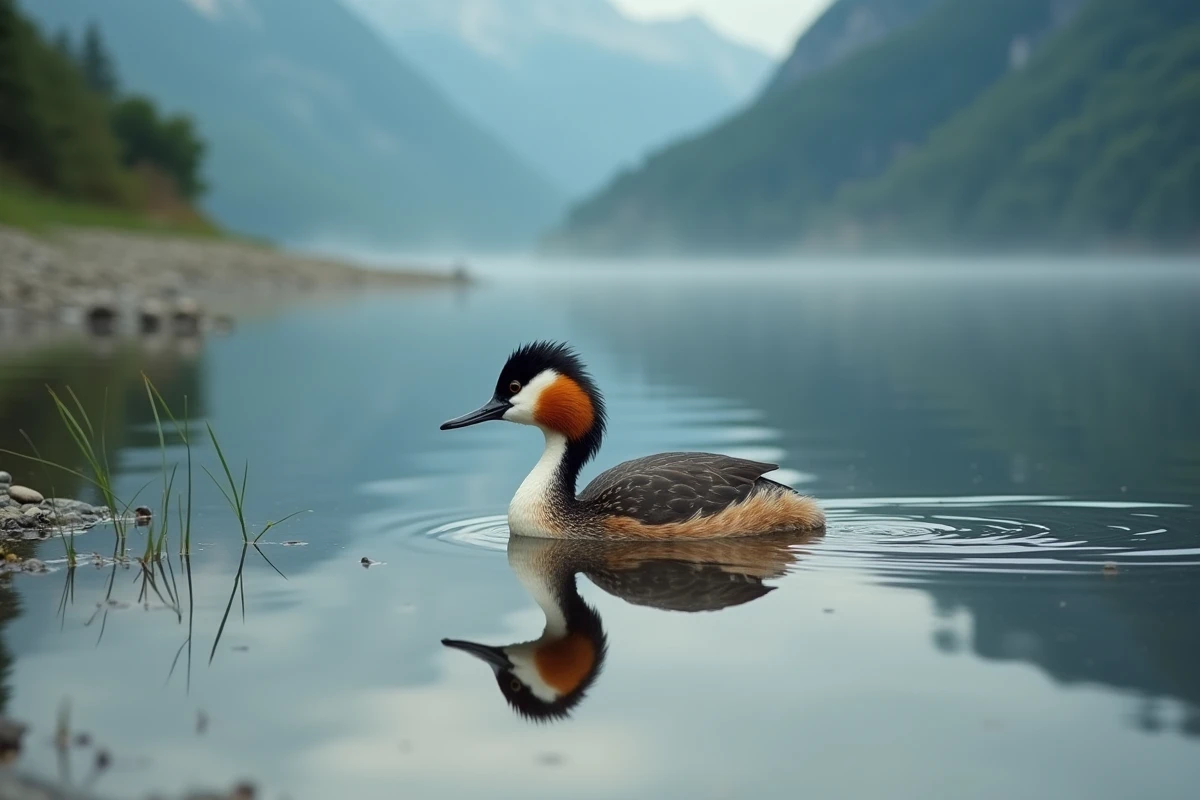
Nesting species visible from Lake Aiguebelette beach in spring
The great crested grebe remains the easiest species to spot starting in April. It can be seen diving a few dozen meters from the shore, sometimes in pairs during courtship displays. The Eurasian coot, omnipresent in the reed beds, can be observed feeding in the open in the morning.
The reed warblers (great reed and marsh) nest in the reed belts. They can be heard well before they are seen. Their squeaky song precisely locates the nest without needing to approach, making the beach sufficient as a listening point.
Thermophilic species on the rise
Ornithological surveys in Auvergne-Rhône-Alpes have noted in recent years the progression of Mediterranean species towards the Savoie lakes. The European bee-eater and the European roller are now among the targets to watch during summer surveys around Aiguebelette. Observations remain occasional, but a bee-eater perched on a wire above the beach is no longer exceptional in July.
Postnuptial migration over the lake: the beach as a counting station
Between late August and October, Lake Aiguebelette lies on a migration route for several groups of migratory birds. Regional migration summaries report an intensification of the passage of swallows, martins, gulls, and terns over the alpine water bodies during this period.
From the beach, these movements can be captured by scanning the sky above the surface. Swallows skim the water to catch insects before gaining altitude, making them very visible to the naked eye. Terns, less frequent, appear in direct flight, often in small groups.
To enjoy this migratory spectacle, one should settle early in the morning facing the lake, with the sun at their back. A counting notebook and standard binoculars (magnification 8 or 10) are sufficient. Returns vary in observation quality from year to year, as the passage depends on weather conditions and high-altitude winds.

Equipment and positioning for observing from the beach
The beach imposes different observation conditions than a forest hide. The ground is flat, clear, and often frequented. One works in open view over a wide body of water, with birds moving on the water or in flight.
- Compact binoculars (8×42 or 10×42) cover most situations, from the grebe resting to the swallow in transit. A spotting scope on a low tripod provides a real advantage for identifying ducks or grebes at a distance, but it remains optional.
- A folding chair or a simple ground mat allows one to stay still for long periods without being noticed. Sitting low to the ground reduces the silhouette and decreases the flight distance of shorebirds.
- A paper identification guide or a mobile app with calls helps confirm the species heard in the reeds, where visual identification is often impossible.
- Subdued clothing (green, brown, gray) avoids standing out against the landscape. Bright colors startle shorebirds and surface ducks.
Preferred time slots
The first hour after sunrise concentrates the most intense activity. Water birds feed, songbirds sing in the reed beds, and the low light makes plumage reading easier. In summer, the beach fills up from mid-morning, which disturbs the shorebirds.
In the evening, the last hour before sunset offers a second peak. Coots and grebes return to resting areas, and grey herons sometimes fly over the lake towards their roosts.
Declining reed beds: a direct issue for the lake’s birds
Studies conducted on Lake Aiguebelette have highlighted a decline in aquatic reed beds, a phenomenon observed across all major European lakes. The causes are multifactorial: regulation of water levels, human encroachment, urbanization of coastal areas.
This decline directly affects the species that observers come to see. Fewer reeds mean fewer nesting sites for reed warblers, grebes, and coots. Preserving these vegetation belts is a priority for maintaining the lake’s biodiversity.
For observers, this implies a concrete responsibility: not to enter aquatic vegetation areas, even when they are not formally prohibited. Repeated passage through a reed bed can be enough to cause a nest to be abandoned. Observing from the beach, at a distance, remains the most compatible practice with the conservation of these fragile environments.