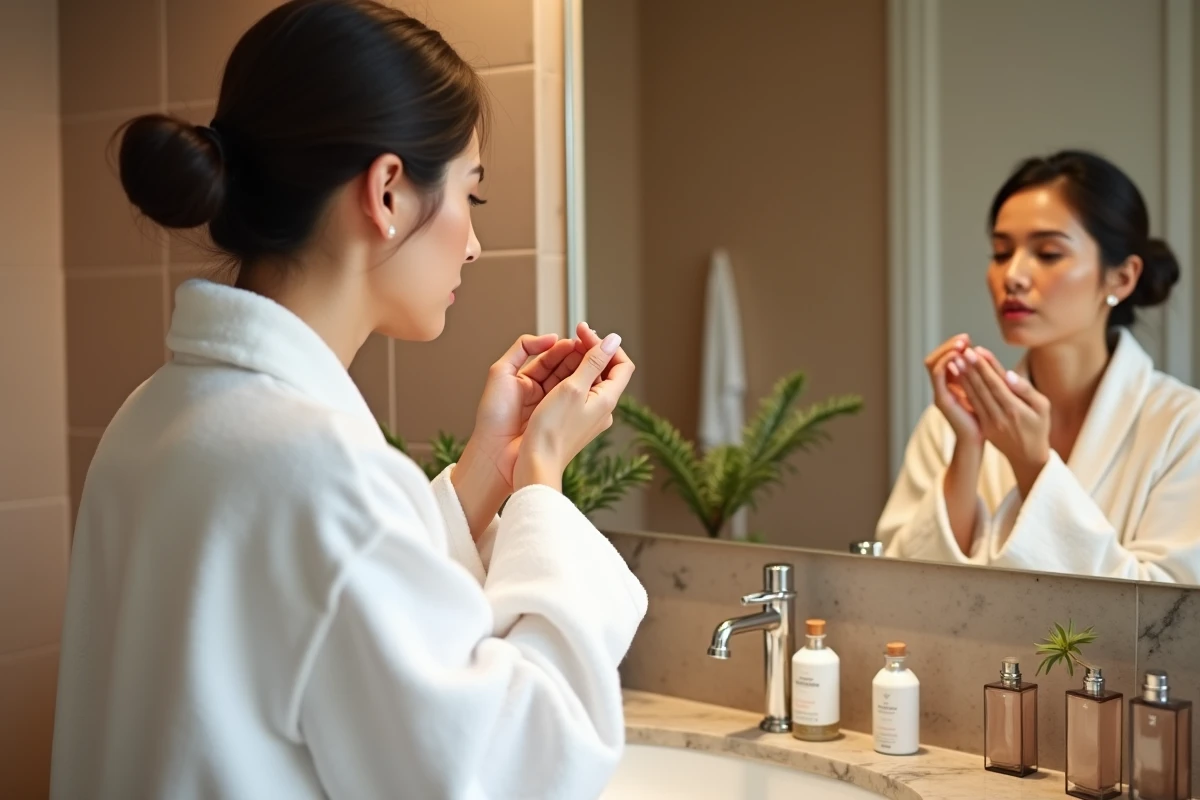
Hormonal fluctuations throughout the menstrual cycle alter sebum production, skin sensitivity, water retention, and even the response to cosmetic actives. Adapting your beauty routine to these variations allows for a more consistent glow without multiplying products.
Beauty routine and hormonal cycle: adapting care to each phase
The menstrual cycle is divided into four main phases, each marked by a distinct hormonal profile that directly affects the skin of the face and body. During the menstrual phase, the drop in estrogen and progesterone often results in a dull complexion and drier skin. The follicular phase that follows sees estrogen levels gradually rise, promoting natural hydration and a smoother skin texture.
Around ovulation, the peak of estrogen generally gives the best glow of the cycle. This is when the skin tolerates exfoliating treatments or lightweight textures better. In the luteal phase, progesterone dominates and stimulates sebum production, which explains the premenstrual blemishes that many experience without always identifying the cause.
Adjusting facial care according to these variations does not require a complete overhaul of your routine. It is more about modulating textures and actives according to the week of the cycle:
- Menstrual phase: favor a rich and soothing treatment, avoid aggressive exfoliants on more reactive skin
- Follicular phase and ovulation: lighten the moisturizer, incorporate a vitamin C serum or a gentle exfoliant to take advantage of the best skin tolerance
- Luteal phase: switch to a mattifying texture, cleanse morning and night with a gentle product to limit excess sebum without stripping
To delve deeper into this type of personalized approach and discover suitable routines, the site belleenforme.fr for beauty offers additional resources on the subject.
Skinimalism: why reducing the number of products improves the skin
The trend of skinimalism involves limiting your daily routine to a maximum of three steps. This movement goes against multi-layer routines that stack serum, essence, ampoule, cream, and oil.
The reasoning is based on a shared observation by several dermatologists: layering too many actives weakens the skin barrier. Skin that is overwhelmed by an excess of products reacts with redness, tightness, or, paradoxically, an overproduction of sebum. Reducing to a suitable cleanser, a targeted treatment, and sun protection is sufficient in most cases to maintain a balanced complexion.
This minimalist approach pairs well with the cyclical adaptation described above. Instead of adding products in the luteal phase, it is enough to replace the targeted treatment with a mattifying active and keep the same gentle cleanser. Simplicity also reduces the risk of interactions between incompatible ingredients, a common issue when mixing retinol, fruit acids, and vitamin C without knowing the precautions for use.
Skin microbiome and topical probiotics: an underestimated lever
The skin hosts a bacterial ecosystem that plays a direct role in its ability to defend against external aggressions. Topical probiotics aim to strengthen this microbial balance rather than disrupt it with antiseptics.
Dermatologists report a visible improvement in glow among users of topical probiotics after three months of regular use. Feedback varies according to skin types and formulations used, but the trend is confirmed in recent dermatological literature.
Products containing lactobacilli or fermented extracts easily integrate into a minimalist routine. They replace a classic serum and are particularly suitable for reactive skin or skin prone to cyclical imperfections. The approach remains emerging, and available publications do not yet cover all skin profiles.

European cosmetic regulation: what changes for your everyday products
The European Union has strengthened its restrictions on endocrine disruptors in cosmetics in 2025. This regulatory evolution directly affects everyday products: soap, body lotion, makeup, perfume. Brands must reformulate their ranges to comply with the new requirements, which sometimes alters the texture or scent of familiar products.
For consumers, this means that reading labels becomes more relevant than ever. So-called “clean beauty” formulas are no longer just a marketing argument: they now meet a stricter legal framework. However, the claim “free from endocrine disruptors” is not yet standardized, leaving room for interpretation by manufacturers.
Points of vigilance on labeling
- Check the INCI list rather than the product’s front claims
- UV filters in some facial treatments are among the molecules reassessed by the EU
- Cosmetics purchased outside the EU (especially online) are not subject to the same restrictions
AI skin analysis: gadget or useful tool
Since 2025, AI skin analysis applications have multiplied. They offer to scan the face to assess hydration, imperfections, wrinkles, and recommend suitable products. These tools are gaining popularity in personalized routines, driven by the democratization of photo sensors on smartphones.
The idea is appealing because it promises a beauty routine adjusted in real-time to skin conditions. In practice, reliability depends on the quality of the algorithm and the shooting conditions. Different lighting or a changed camera angle can distort the analysis.
These applications present real interest for individuals who struggle to identify their skin type or who seek a starting point before consulting a dermatologist. An examination by a professional remains the reference for a reliable diagnosis, but they provide an accessible first filter to guide the choice of a cleanser, treatment, or suitable makeup.
The most effective approach remains to cross-reference this digital data with personal observation, taking into account cyclical and seasonal variations. An analysis tool used twice a month, at different times of the cycle, provides a more accurate picture than a one-off scan taken on a good skin day.