
Amateur football in Haute-Saône operates under a precise disciplinary framework, articulated between the federal regulations of the FFF, the directives of the Bourgogne-Franche-Comté League, and local decisions from the District. Understanding this framework requires going beyond a simple reading of the scales to examine the concrete mechanisms that determine a sanction, its follow-up, and its real consequences for a player or a club.
Computerized match sheet and traceability of sanctions in Haute-Saône
Even before discussing scales, the most significant structural change in recent years concerns the Computerized Match Sheet (FMI) and the Footclubs platform. The Haute-Saône District mandates their use for all disciplinary follow-up.
Every sanction imposed, from a simple warning to a long suspension, is recorded in a centralized federal database. A sanctioned player in Haute-Saône who changes clubs or districts does not start from scratch. Their disciplinary history follows them.
This point deserves to be emphasized because it profoundly changes the situation for local clubs. Before this centralization, a licensed player could change structures and see their disciplinary records disappear into administrative gaps between districts. The FMI renders this practice obsolete. To delve into the mechanisms of appeal and the details of procedures applicable at the departmental level, a comprehensive summary is available on the site Les Héros du Sport, which details each step of the process.
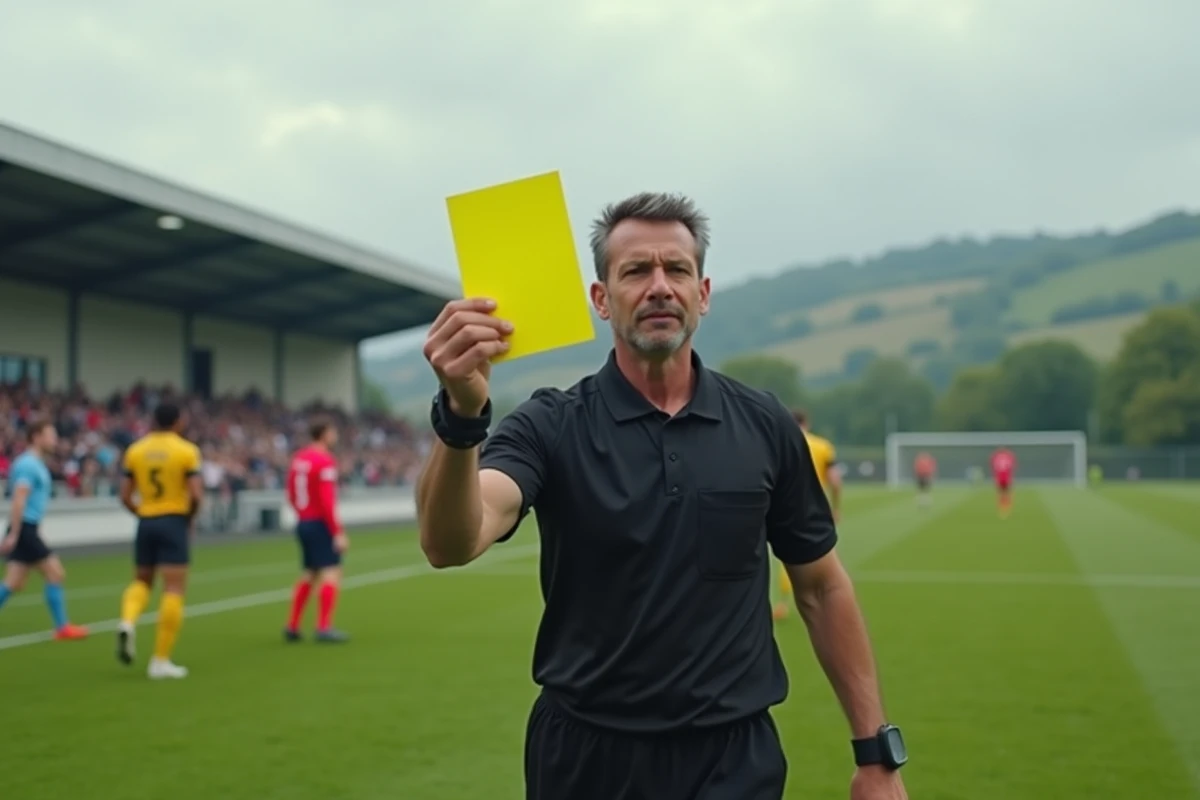
FFF disciplinary scale and tightening of sanctions for violence
Since the 2023-2024 season, the District has been applying the updated FFF disciplinary scales, in alignment with the federal circular issued on July 7, 2023 regarding the fight against violence. This text primarily targets serious violence, namely physical attacks on a referee or match official.
The tightening is significant compared to the scales in effect before 2020. The minimum suspensions for this type of infraction have been raised, and the disciplinary commissions have less leeway to mitigate the minimum penalties.
What the circular concretely changes
The gradation of sanctions depends on the nature of the act and the status of the victim. An action against an opponent does not carry the same scale as an action against a referee. For violence against officials, the minimum suspensions have notably increased compared to previous references.
Clubs have a direct role in this system. Anyone listed on the match sheet or mentioned in an official report can be summoned before the Departmental Disciplinary Commission. However, a person absent from these documents cannot be heard in a hearing, which sometimes poses difficulties when the incident involves spectators or unregistered companions.
Procedure before the District Disciplinary Commission
The disciplinary commission of the Haute-Saône District meets regularly at the District headquarters in Vesoul. Sanctions take effect the day after the meeting, unless otherwise specified. This point is often misunderstood by clubs, which sometimes assume there is a notification delay before application.
Another element to remember: notifications published on Footclubs have official status in case of disputes. A club that has not consulted the platform cannot claim ignorance of the sanction.
Right to defense and hearing
Any licensed individual excluded during a match by the referee’s decision can assert their defense under the conditions set by the FFF disciplinary regulations. This includes the possibility of being heard in a hearing, but only if the person is listed on the match sheet or in the official report.
- The player or official must submit their request within the deadlines set by the regulations, under penalty of forfeiture.
- Only individuals listed on the match sheet or named in the officials’ reports are eligible to be heard.
- Any objections filed by a club after the match must follow a specific formal procedure; otherwise, they are inadmissible.

Regional control of disciplinary decisions from districts
The reform of the statutes and regulations of the Bourgogne-Franche-Comté League adopted in 2022 introduced a post hoc control of the decisions of the district disciplinary commissions. This mechanism aims to harmonize practices across the different departments of the league and to limit disparities in treatment.
This control extends to specific areas, including sanctions related to sports betting. The League can intervene if a district decision clearly deviates from the federal scale or if the procedure followed presents irregularities.
A safety net, not an appeals court
This regional control does not replace traditional avenues of appeal (appeal before the competent commission). It functions more as a consistency audit. The available data does not allow for precise measurement of the frequency of these regional interventions, but the very principle of this oversight alters the balance between local autonomy and federal framework.
- The control focuses on the conformity of the procedure and the proportionality of the sanction in relation to the scale.
- Sanctions related to sports betting receive particular attention from the League.
- A district can no longer apply a personalized scale in contradiction with federal directives without risking a regional correction.
The disciplinary framework of the Haute-Saône District is part of a logic of increasing centralization, driven by the FMI and regional control. For clubs and licensed individuals, precise knowledge of these mechanisms, from filing objections to the mandatory consultation of Footclubs, directly conditions their ability to exercise their rights of defense within the allotted time.