
DNews operates on two channels with very different logics: a downloadable application from the Android store and a video presence on Google’s streaming platform. Comparing these two access points amounts to measuring concrete differences in terms of interface, content management, and user control.
DNews on Google Play versus YouTube: feature comparison table
| Criterion | Google Play App | YouTube Channel |
|---|---|---|
| Main content format | Articles, text feeds, push notifications | Video, shorts, livestream |
| Catalog customization | Choice of sections, thematic filters in the interface | Recommendation feed driven by algorithm and viewing history |
| Advertising model | Integrated banners, mobile data consumption | Pre-roll, mid-roll, overlay ads |
| Moderation and recourse | Play Store rules, reporting via the store | YouTube community guidelines, obligations reinforced by the European DSA |
| Offline accessibility | Possible caching depending on the app | Download limited to Premium subscriptions |
| Paid subscription | Free (basic version) | Free with ads, YouTube Premium option |
This table reveals a structural difference. The app offers direct control over the sections viewed, whereas YouTube delegates a large part of the selection to its recommendation engine.
Before choosing between these two access points, it is useful to understand how to use DNews on Google Play or YouTube according to one’s viewing habits.
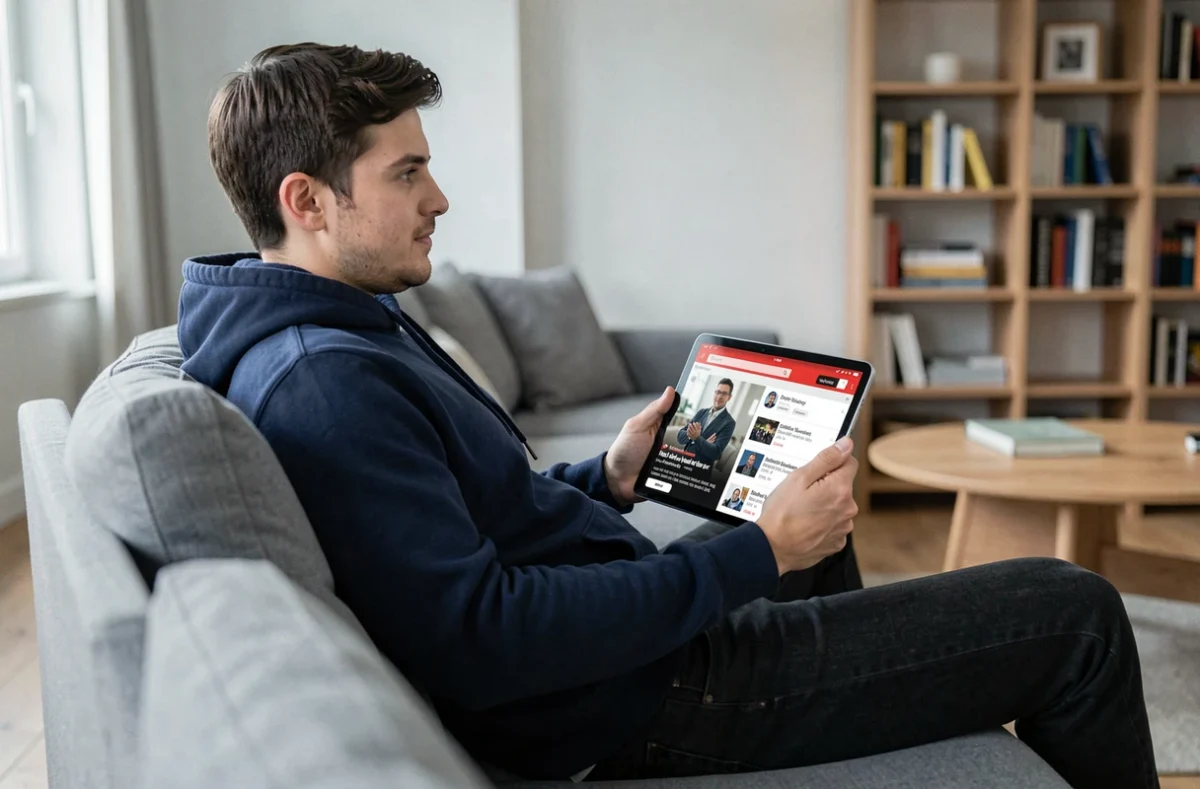
YouTube recommendation algorithm and news feed on Google Play: two dissemination logics
On YouTube, the content offered depends on viewing history, interactions (likes, time spent on each video), and the behavior of similar profiles. This logic favors continuous consumption rather than an organized consultation of multiple sources.
YouTube now allows users to customize their video feed in natural language, but this feature remains geographically limited and requires a connection to the account. The user does not have control over the display order in the same way as with a traditional aggregator.
On the Play Store, the DNews app functions as a standalone service. The user accesses a catalog of sections that can be reorganized. Content updates come through configurable notifications, not through an algorithmic feed that decides for them.
Information bubble effect
The YouTube feed tends to reinforce already identified interests. In terms of news, this can reduce the diversity of displayed viewpoints. A dedicated app limits this effect by presenting a broader thematic panorama by default.
The choice between the two thus depends on what one expects: a continuous and personalized video feed, or a structured consultation where one selects their sections.
Moderation, transparency, and European obligations on each platform
YouTube is subject to the Digital Services Act (DSA), the European regulation on digital services. This text imposes transparency obligations on very large platforms regarding their recommendation algorithms, content moderation, and researchers’ access to certain data.
For the DNews user on YouTube, this means a stricter regulatory framework regarding reporting and recourse. The DSA requires YouTube to explain why content is recommended and to offer options to modify these recommendations.
On Google Play, the DNews app is subject to the store’s rules (security checks, mandatory privacy policy), but the moderation of the content displayed in the app is the responsibility of the publisher itself. Recourse goes through the developer, not Google.
What this changes concretely
- On YouTube, problematic content can be reported via the platform’s tools, with a process governed by the DSA for European users
- On the Play Store app, reporting first goes through the DNews publisher, with timelines and guarantees that vary according to its internal policy
- Transparency regarding data collection is more regulated on YouTube (reporting obligations), while the app must comply with Play Store rules without the same level of public oversight

Advertising and data consumption: the real cost of each access
Editorial comparisons rarely mention two parameters that weigh on the daily experience: intrusive advertising and mobile data consumption.
On YouTube, video consumes significantly more bandwidth than a text feed. A user who accesses DNews via video on a limited plan will see their data consumption increase much faster than with the app. The video format multiplies data consumption compared to the text format, a point to consider for daily consultation.
Regarding advertising, YouTube inserts ads before and during videos (pre-roll, mid-roll). The app on the Play Store generally displays less intrusive banners, although their frequency depends on the business model chosen by the publisher.
- YouTube without a Premium subscription: mandatory video ads, sometimes non-skippable
- Play Store app: banners or boxes, often closable with a single gesture
- YouTube Premium removes ads but represents a recurring monthly cost
For quick news consultation, the app remains more economical in terms of time and data. The video format is more justified when the goal is to delve deeper into a subject or follow a report visually.
The choice between Google Play and YouTube to access DNews boils down to a question of format and control. The app gives control over the selection and management of sections. YouTube offers a rich video universe, at the cost of greater dependence on the algorithm and higher resource consumption. Usage determines the right channel: structured consultation on one side, video immersion on the other.