Domestic disorder is not just a question of aesthetics. In recent years, several public health research studies have pointed to a link between living environments and mental health. The organization of housing is now included in the recommendations for adapting daily life. This framework gives a new dimension to decluttering and organizing efforts: they are no longer just a matter of decor advice, but a documented well-being issue.
Tax credit and CESU: the real budget for assisted decluttering
Since 2023-2024, several home organizing services have positioned themselves as personal services. This status allows individuals to benefit from a tax credit through the CESU system for decluttering and home organization services. This extension to domestic organization professions is among the eligible personal service activities.
This point changes the game for anyone considering hiring a professional. The net cost of a home organizing service can be halved thanks to this tax advantage, making the use of an external provider more accessible than one might think.
Before embarking on a solo sorting marathon, it may be useful to consult the practical advice from Conseil Habitat to assess the scope of the project and choose the right method.
What the system covers (and does not cover)
The tax credit applies to home intervention hours carried out by an approved organization. However, the purchase of storage furniture, boxes, or accessories remains the responsibility of the individual. The distinction is clear: the service is subsidized, the materials are not.
The duration of intervention varies greatly from one household to another. Some resolve the issue in a single accompanied day, while others need several sessions spaced over a month. The volume of accumulated items and the size of the home play a role, but the emotional difficulty of parting with certain possessions often weighs more heavily.
Decluttering by zones: why the room-by-room method often fails
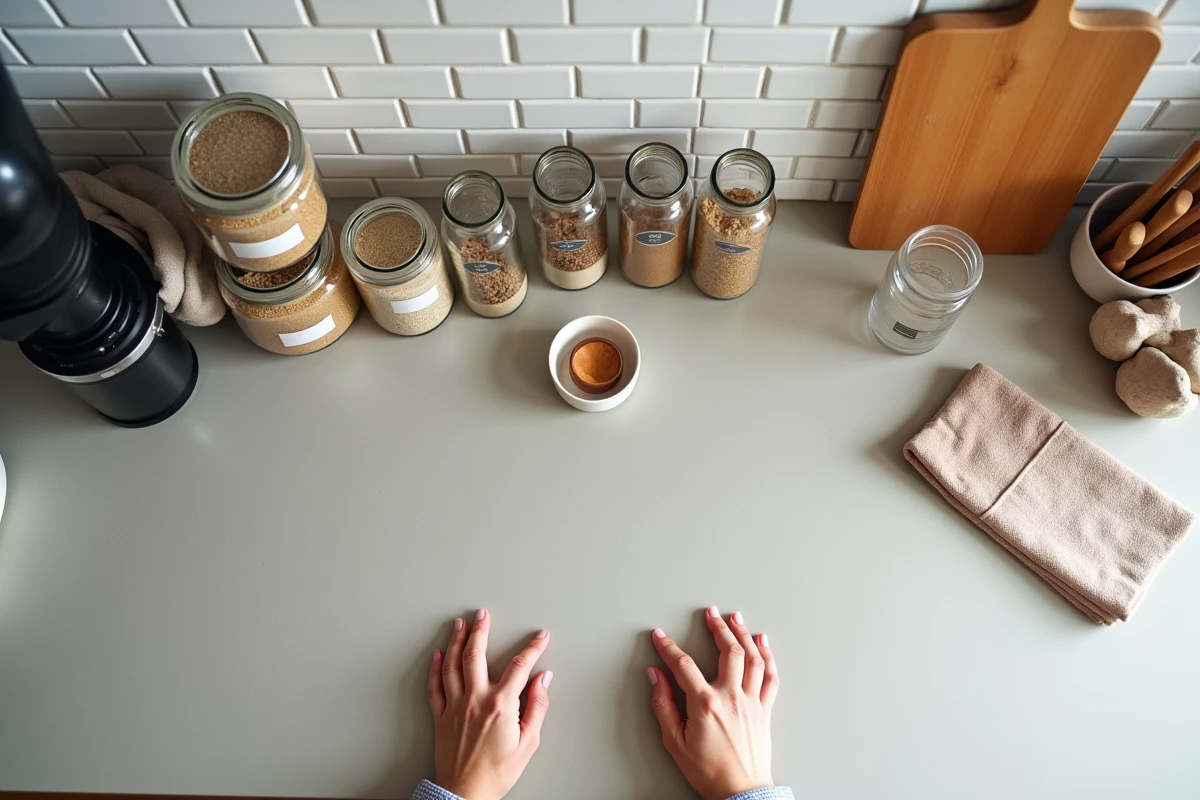
Sorting room by room seems logical, but it encounters a concrete problem: items do not respect the boundaries of rooms. A winter coat may be left in the bedroom, a phone charger may migrate from the living room to the kitchen. Thinking by category of items rather than by room forces one to gather all similar items, making duplicates and excesses visible at once.
This category-based approach (clothes, papers, utility items, sentimental items) is the one recommended by the majority of trained home organizers. It requires more preparation, as items must be moved from one area to another even before sorting. The result is more sustainable because decisions are made globally, not through repeated micro-choices in each room.
Defining flow zones rather than storage zones
A harmonious home is not one where every item is stored, but one where every item flows logically. Three questions can help assess any space:
- Is the item used in this area at least once a week? If not, it probably belongs elsewhere or nowhere.
- Does it take less than ten seconds to put it away? A complex storage solution will not be maintained over time.
- Would someone else in the household be able to find this item without help? If the answer is no, the system relies on one person and will eventually collapse.
A storage solution that requires motivation to maintain is poorly designed. The goal is to create habits, not discipline.
Reuse and local authorities: what to do with sorted items
Sorting generates a sometimes considerable volume of items to dispose of. Throwing them away at a waste facility is the quickest solution, but the least virtuous. Several local authorities have structured alternative channels in recent years.
The City of Paris updated its Charter for the reuse and recycling of everyday objects in 2024. The Lyon Metropolis has been running the “Light House, Sustainable City” program since 2023. These initiatives facilitate donation, resale, and recycling at the local level.
In practical terms, this means that decluttering can rely on dedicated collection points, partner resource centers, and sometimes home pickups for bulky items. Checking what your municipality or intermunicipality offers before starting the sorting process helps avoid being overwhelmed by bags without a destination.

Housing accessibility and organization: an underestimated angle
Since the reform on adapting housing for aging and disability, implemented in stages starting in 2023, occupational therapists have increasingly intervened in domestic organization projects. Their perspective differs from that of a traditional home organizer: they assess the height of storage, the width of passages, and the ease of grasping everyday objects.
A well-organized home for a person with reduced mobility is often a better-organized home for everyone. Placing heavy items between waist and shoulder height, clearing floors, and removing obstacles on the ground also benefits families with young children or temporarily injured individuals.
Feng shui and energy flow: what practice says
Feng shui regularly appears in research related to interior organization. Its principle of energy flow (the “chi”) overlaps with a functional reality: a cluttered space hinders movement and creates a feeling of blockage. The available data do not allow for conclusions about strict energetic effects, but the correlation between a clear interior and a reduction in perceived stress is documented by the aforementioned research.
The most pragmatic approach is to take from feng shui what pertains to ergonomics: do not place anything behind a door, keep work surfaces clear, and avoid accumulating items in passage areas. These principles work independently of any belief.
Transforming a disordered house into a harmonious space relies neither on a weekend of intensive organizing nor on the purchase of matching boxes. The result depends on category-based sorting, an organization designed around the flow of objects, and sometimes professional support whose cost can be partially covered. Local reuse channels and housing adaptation initiatives complement this approach with concrete solutions.